
Judges
Growing in Christ
"He opened their minds so they could understand the Scriptures." Luke 24:45
Overview of Old Testament or New Testament
Links to observations drawn from other other books of the Bible
Practical and Pastoral Observations on the Book of Judges (please read each chapter slowly and meditatively before reading observations below):
Introduction: Moses and Joshua had been strong leaders, unifying and leading Israel into the promised land and subjugating much of it. At Joshua's death however no replacement leader was designated or selected leaving each of the tribes to make their own way to cleanse their own portion of the land from paganism without the support of the rest of Israel, as had been the case since the Exodus. Leaderless, Israel floundered as a loose confederacy. There was neither a strong high-priest bringing the people together at Shiloh for worship nor a strong political leader to coordinate the task of cleansing the remainder of the land.
A cyclic pattern ensued in which Israel drifted from the worship of Yahweh and "did what was right in their own eyes" (17:6; 21:25) weakening them as they followed their own whims and desires. In this vacuum of spiritual and political leadership Canaanite groups sought to reclaim their traditional land. The Lord frequently intervened to raise up "judges" (civic and military leaders), some of whom ruled concurrently since they didn't necessarily have national influence.
The author is not stated but the Talmud suggests Samuel as compiler / editor of the historical summary of this period (c.1353-1065 BC).
Judges 1
Limited collaboration, limited success: Rather than going together against the remaining Canaanites, the tribes cast lots for who would go alone against them first (v.1). When Judah was chosen, Judah proposed a receiprocal collaborative effort with Simon (v.2) and this limited joint effort had significant success (v.4, 8-13, 17-18) but could not advance against defenders with iron chariots (v.19).
No collaboration, no success: Without tribal collaboration Joseph gained a city (v.23-26) but no additional success is recorded, and the other tribes, working alone, made no gains against the Canaanites (v.21, 27-33). Dan even lost the small bit of land it had (v.34; ch.18). In some cases Canaanite were pressed into forced labour (v.28, 35) but in many, and perhaps most cases, the Canaanites continued to live among the Israelites and influence them (v.16, 21, 27, 29, 31-33).
Stalled: How could this situation have come about? Factors certainly included the fact 1.) Joshua appointed no successor and 2.) the tribes ceased the effective collaboration which marked their initial entrance into Canaan. But the primary reason, Israel's failing relationship with the Lord, is detailed in the next chapter.
Sadly, this is only the first time God's people had "the land" but did not hold it. The danger is sometimes military or political but always spiritual and the danger reoccurs every generation.
Whole-hearted and persistent love for the Lord and full obedience to Him in spiritual unity of purpose is the irreducible core of success for God's people.
Personal Response: I will seek collaboration with God's people in every sphere in which Christians may be found. Lacking collaboration, I will, in my generation, hold "the land" for His possession as the Lord enables me.
My Prayer: Father, may your people be one. May we be one in seeking your face, one in love and obedience, one in advancing your Kingdom in every social sphere and geography.
Judges 2
The LORD's Warning: Scripture isn't specific about who or how the angel (messenger) of Yahweh appeared or spoke, but we can be confident God is always able to make His heart known. The truth is God is always faithful to his people (v.1) but His people are not faithful to Him (v.2), sadly then suffering the consequences of their unfaithfulness (v.3). Israel had not torn down the Canaanite altars (v.2) leaving pagan demons to be a snare to them (v.3).
Joshua's Generation: Joshua's generation acknowledged Yahweh's rebuke and grieved the truth of it (v.4) and worshipped the Lord (v.5). Then they returned to their land (v.6), presumably to remove the remaining pagan altars from the land. To what degree they did so we are not told but, after Joshua's death (v.8), the generation of those had seen God's mighty hand remained overall faithful to the Lord (v.7).
The Following Generation: How could the generation that followed so abruptly "not know" the Lord (v.10-11)? Perhaps they were mesmerized by the glitter of the pagan idols or did not take in the history of their people told them by their parents, or were not discipled by the Shema of their parents. It may also be since Israel's worship was centralized at Shiloh while pagan worship was de-centralized to every "high place," the proportion of Israel traveling to Shiloh was comparatively small.
v.10-11: All that generation were gathered to their fathers. And there arose another generation after them who did not know the LORD or the work that he had done for Israel. And the people of Israel did what was evil in the sight of the LORD and served the Baals."
Results of Human Unfaithfulness: When Israel forsook the Lord and instead worshiped pagan demons (v.12-13), 1.) God grew angry, and 2.) ceased to deliver them from their enemies (v.14), resulting in 3.) Israel experiencing severe distress (v.15).
Results of God's Faithfulness: 1.) God was moved to pity (v.18) and 2.) raised up faithful Judges to call Israel back to Him and deliver them from their oppressors (v.16, 18), yet 3.) Israel gained no lasting wisdom from the experience (or failed to relay it to their children) and returned to more unfaithfulness (v.19).
For this reason God left the Canaanites in the land 1.) to punish Israel (v.20), 2.) to test them (v.22) and 3.) to train a generation, yet without war experience, how to conduct themselves for that necessity (3:2).
It appears the visible representations of their neighbour's demons, seen daily by Israel, were more memorable than the God who is Spirit (John 4:24) who they could not see in the same way. Materialism and the god of mammon has a similar visual appeal.
Personal Response: I will tell the next generation the ways of the Lord and of my experience of His grace, guidance and protection. I will teach them the spiritual disciplines they need to stay close to the Lord and how to teach their children and children's children, to the 4th generation.
My Prayer: Father, help me pass on the urgency of this generational call and task to my children without irritating them with the impression that I feel they are not taking it seriously or falling short in some way. Lord, help me pray for them diligently in the challenge before them knowing myself how challenging the task is in a culture pulling the other direction.
Judges 3
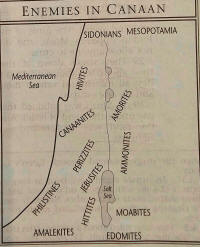
Israel's Enemies were all around and among every tribe of Israel (v.2,5), as depicted also in the chart (left, from Ryrie's NASV). Israel foolishly intermarried with them (v.6) which led to incorporating their false gods, serving their Baals and his consort Asheroth (v.7). In response, Yahweh essentially said: "You want to serve demons? See how powerless they are in protecting you from your enemies."
Oppression and Deliverance:
Cycle 1:
Yahweh handed Israel over the king of Mesopotamia and he oppressed them for eight years (v.8) before Israel cried out to Him (v.9). God then graciously put His Spirit on Calab's younger brother Othniel who overthrew Cushan-rishathaim, king of Mesopotamia (v.10) and Israel had rest for 40 years (v.11).
Cycle 2:
After having chosen righteousness, Israel again chose wickedness (v.12) and Yahweh handed Israel over to Eglon, king of Moab (v.13) who oppressed them for 18 years (v.14) before Israel turned again to the Lord for deliverance (v.15). God then raised up Ehud, a bold and courageous man who killed Eglon (v.16-26) and rallied Israel to rout Moab (v.27-29), giving Israel peace for 80 years (v.30).
Cycle 3:
When the Philistines attacked, God raised up Shamgar, saving Israel (v.31).
Personal Response: I will resist Canada's slide to worship the gods of this world to avoid the oppression of these false gods which inevitably follows.
My Prayer: Father, raise up prophets and apostles to call your church to faithfulness in our day.
Judges 4
Cycle 4: When Ehud died, Israel again turned away from the Lord to the idols of demons (v.1). God punished them for 20 years by Jabin, king of Canaan (v.2), then Israel turned again to ask deliverance from the Lord (v.3).
Deborah: While Jabin exacted tribute, Deborah judged disputes between the Israelites (v.4), showing wisdom and having been attributed authority by the people. Using this authority, Deborah made a plan and called Barak to implement it with her (v.6-7). Assured of her full support (v.8-9), Barak gathered an army of 10,000 (v.10) and Sisera, commander of Jabin's army, was notified (v.12) and responded (v.13). Yahweh strengthened Israel to route Sisera who fled on foot (v.14-16).
Jael: Jael, the wife of Heber (v.11,17), a Kenite (descended from Cain), offered to hide Sisera in her tent (v.18) and gave him nourishment (v.19) but killed him in his exhausted sleep (v.21). When Barak arrived, Jael showed him her victory over the commander of Jabin's troops. Jabin was overcome (v.23f), Israel was free. God delivers His people who repent and turn to Him.
Personal Response: When godless men and women corrupt our culture and call evil good, I will call on the Lord to raise up the righteous to route evildoers from the land.
My Prayer: Father, may your people repent and may You route evil. May we know a love for You and Your righteousness in the land.
Judges 5
Story in Song: The history of Judges 4 is celebrated in song with additional details and emphases.
1.) There is a cost to be paid in leading and in following, both are needed and the provision of each is a gift from the Lord (v.2).
2.) The source of victory is the Lord (v.3-5).
3.) The source of oppression was from a) the choice of untested "new gods" instead of their proven and faithful Yahweh as well as b) from the inability of Israel to defend themselves (v.8).
4.) Joy in singing the Lord's victory is for all: the rich (v.10), working shepherds and poor peasants (v.11). /p>
5.) Those who volunteered to fight are celebrated (v.14-15, 18-19) and those who refused (v.15-17, 23) are rebuked.
6.) God used nature, including torrential rains, to fight against Sisera (v.20-22).
7.) Jael's courageous assassination of Sisera is recounted (v.24-27) as is Sisera's mother's anxiety at his failed return (v.28-30).
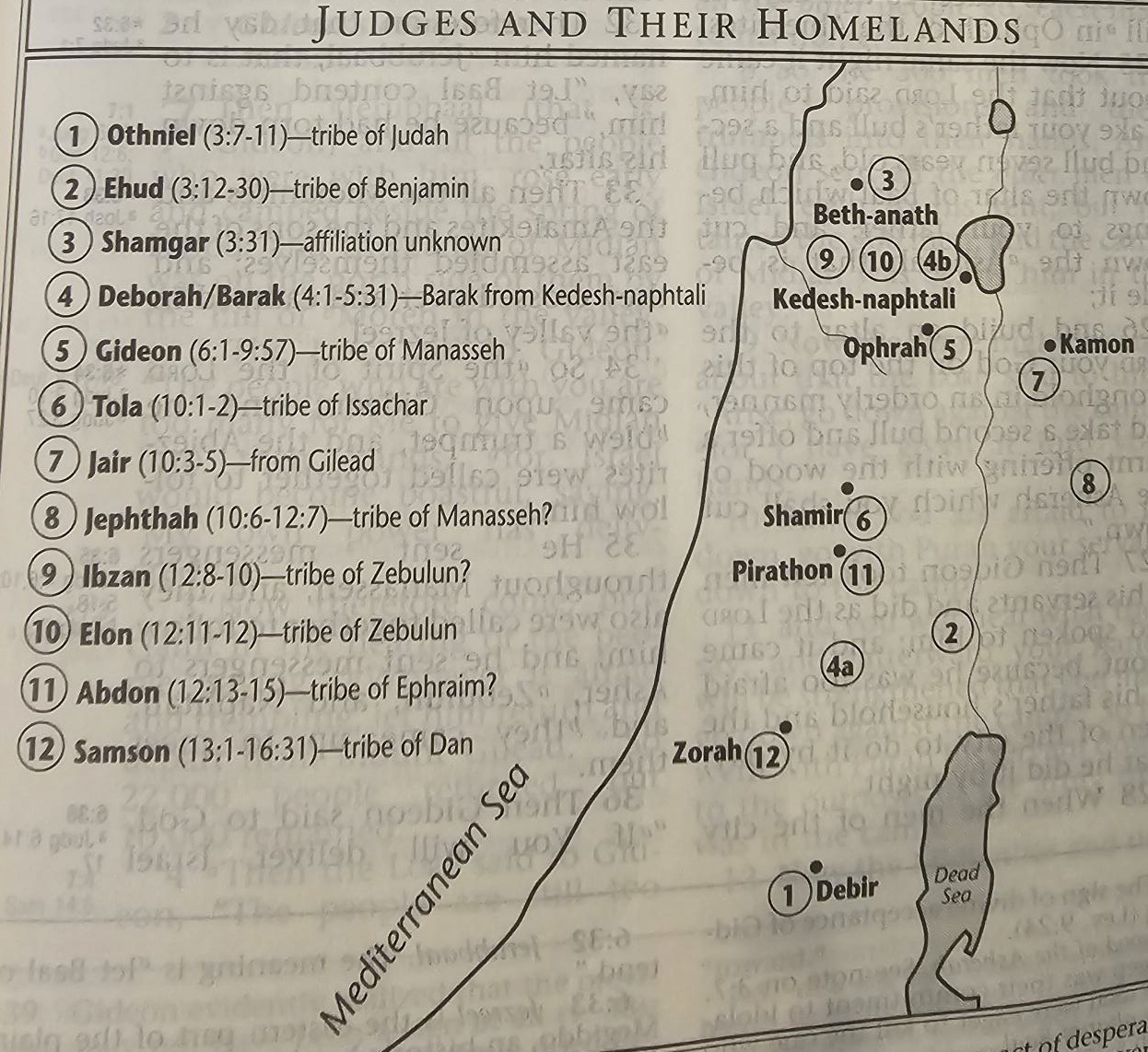 |
| Image from Ryrie Study Bible |
8.) God's people are now urged to march on with strength (v.21 as of the rising sun in it's might (v.31). God's gifts to those who love him include both victory and peace (v.31)
Personal Response: I will embrace the Lord with all my heart. In His service I will volunteer to serve either as leader or follower (v.2).
My Prayer: Father, thank you for times of stillness in Your presence, hearing you encourage, direct and assure. The greatest gift is to be with You.
Judges 6
Idolatrous Israel in Hiding: After 40 years of peace (5:31) Israel again turned to idols and God allowed the Midianites, aligned with the Amalekites and "sons of the east" (v.3) to subdue them at will and annually destroy Israel's crops (v.4). An unnamed prophet made clear the reason Israel had been reduced to hiding in their own land (v.2, 10).
Gideon's Calling: God appeared to a grandson of Manasseh in theophany (v.11) hailing him as a warrior (v.12), hearing Gideon's objections (v.13,15) and overruling him (v.14, 16). Gideon asked for a sign that it was the LORD (v.17) so the LORD told him to place the meal he had prepared as offering on a rock (v.20). The angel of the LORD then touched the offering with his staff and fire sprang up to burn it, and the angel disappeared from his sight (v.21).
Gideon's Test: The LORD then called Gideon to tear down his father's idols (v.25), build an altar to sacrifice his father's oxen and use the wood of the idols for the offering(v.26). Gideon did so by night (v.27) and when the men of the city discovered it (v.28-29) they demanded that Gideon die (v.30). Gideon's father defended him, arguing that if Baal was truly a god he could contend for himself (v.31) and changed Gideon's name to make that point (v.32).
Time to Lead: When the Midianites returned (v.33) God's Spirit rested on Gideon (v.34) and he called four of Israel's tribes to send men to fight (v.35). As they assembled Gideon asked the LORD to renew again His call to this dangerous task, which the LORD did, first in keeping dry the ground and then the fleece (v.36-40).
God chooses reluctant leaders who rely in Him to accomplish His work and will gives signs to confirm His calling.
Personal Response: I will trust the LORD when He calls me to do what I fear to do because it is He who calls and is with me.
My Prayer: Father, may I hear your call. Give me courage overcoming fear.
 Murray Moerman (