
Joshua

Growing in Christ
"He opened their minds so they could understand the Scriptures." Luke 24:45
Overview of Old Testament or New Testament
Links to observations drawn from other other books of the Bible
Practical and Pastoral Observations on the Book of Joshua (please read each chapter slowly and meditatively before reading observations below):
Introduction: Joshua, whose name means "Yahweh is salvation" is the name name as Jesus who is the salvation of Yahweh. The book is written largely as an eye-witness account by the author, Joshua himself (cf. chapter 24). Joshua recounts the conquest and division of the land promised to the children of Israel. The Ras Shamra Tablets describe the Canaanite religion as involving prostitution of both sexes, infant sacrifice and other corrupt and brutal practices which God wanted removed rather than be incorporated into the life of His people. This theme of avoiding syncretism is an important theme through the Scriptures as salvation comes from Yahweh alone.
Joshua 1
Succession Plan: Moses had laid hands of Joshua (Deut 34:9) and now the Lord called Joshua to step into his role with courage. Three times the call to be strong and courageous is given (v.6,7,9).
 God's
promises: include the broad boundaries of the promised land
(v.3-4), success and victory over those competing for the land (v.4, 6, 7,
8), and His unfailing presence throughout (v.4, 8).
God's
promises: include the broad boundaries of the promised land
(v.3-4), success and victory over those competing for the land (v.4, 6, 7,
8), and His unfailing presence throughout (v.4, 8).
God's conditions: be strong and courageous (v.7), keep the covenant given (v.7), meditate continually on the conditions of the covenant (aka the law v.8) in order to live it out.
Joshua Steps Up as Leader: Joshua notified the people of his plans to cross the Jordan (v.11) and called for their loyalty. Joshua called the 2 1/2 tribes (who Moses promised (see Num 32) could settle in land east of the Jordan) to keep their promise to help take all the land before returning to their land (v.12-15). The strong response of the 2 1/2 tribes (v.16-18) was critical to success of unified Israel. The 2 1/2 tribes promised to enforce the required discipline among their own ranks (v.18). All they asked of Joshua was the Lord's blessing on Joshua (v.17) and his unfailing courage (v.18)
What is required for the success of God's people? Unity, courage, full obedience to the Lord and the provisions of our relationship with Him and loyalty to the leadership appointed by God to the end of our task and calling.
Joshua 1:9: Have I not commanded you? Be strong and courageous. Do not be frightened, and do not be dismayed, for the LORD your God is with you wherever you go."
Personal Response: I will do what is required for the success of God's people and urge others to do the same.
My Prayer: Father, in our spiritual warfare against the
powers of darkness, encourage your people this day to learn and live as you
called the people of Israel standing before the Promised Land. May we
likewise be strengthened to meet the conditions of success you have laid
out.
Joshua 2
Second Spy Expedition: 40 years after Moses's 12 spies returned with a negative report which frightened the people (Num 13-14), Joshua sent 2 spies, secretly even from Israel, lest a discouraging report again dishearten Israel (v.1).
Rahab: Entering Jericho took great courage for the spies. Part of their strategy may have been the expectation that harlots ask fewer questions. Not surprisingly, the spies had already been seen and reported to the authorities (v.2). Their clothing or complexion may have given away the fact they were Israelites from Egypt (v.3). Rahab directed those searching for the spies to the road back to the Jordan were the spies had crossed, a logical supposition (v.7).
Rahab's Pragmatism born of Faith: The reputation of Yahweh, the God of Israel, had been known in Canaan since the crossing of the Red Sea and the overcoming of the Amorites (v.10). Rahab's conclusion was that Yahweh was greater than the gods of the Canaanites and would give the land to Israel (v.9). Whether a pragmatic conclusion or true faith, she acknowledged Yahweh as the God of heaven and earth (v.11).
Rahab's Covenant Proposal: Anticipating the possibility or more likely, the certainty of Jericho's destruction, Rahab proposed an transactional agreement: kindness for kindness (v.12), not only for her life but also those of her father's household. The spies agreed but added conditions: Rahab's father's household would have to be in one place (18-19) in the home marked by a scarlet cord in the window and Rahab would keep what she knew from her countrymen (v.20).
Escape: the spies hid themselves for three days in the hills (v.22) to the west of the city while those who pursued them went east to the Jordan (v.7).
God redeems all those who turn to him, including Rahab whose redemption placed her into the genealogy of the Redeemer (Matt. 1:5). The spies for their part were willing to bind themselves in a blood-covenant (v.19) to her.
Joshua 2:19: "Then if anyone goes out of the doors of your house into the street, his blood shall be on his own head, and we shall be guiltless. But if a hand is laid on anyone who is with you in the house, his blood shall be on our head."
Personal Response: I will make substantive agreements and hold myself to them, modelling for a faithless world what it means to be a man of my word even as God is always true to His Word.
My Prayer: Father, thank you for your covenant-faithfulness. Thank you that we can rely on you, giving us courage to be reliable in our relations with others. Lord, may this transformative trait be a model which spreads through all the earth!
Joshua 3
Three Days: The courage to which God called Joshua (1:1-9) was not only to be expressed in battle but in trusting God for the miraculous. A vast people of c.2 million people came to the Jordan's edge (v.1), where they rested for 3 days (v.2) while they received instructions (v.3-4) and consecrated themselves to the Lord (v.4) for "you have not passed this way before" (v.3) and "the Lord will do wonders among you" (v.4). In this God promised he would be with Joshua as he had been with Moses (v.7).
The Ark First: The presence of the Lord was carried about 1 km ahead the people (v.3). The Lord always goes before His people (v.6, 11). After the ark came about 40,000 men from the 2 1/2 tribes dressed for battle (4:12-13), then the other tribes and their flocks.
Act of Faith in Response to Word of Promise: The priests carrying the Ark were to step into the Jordan and wait for the Lord to act (v.8). The Lord speaks (v.9) and His promise is true. Just as surely as the waters of the Jordan will be cut off upstream (v.13), the people occupying the land beyond will be driven from the promised land. “By this you will know that the living God is in your midst" (v.10).
The Hand of God: The priests carrying the ark stepped into the water in faith and obedience. The Jordan (lit. the "descender") descends 1,000 feet between the Sea of Galilee and the Dead Sea through 27 rapids. At Jericho it is 50-60 yards wide. During harvest it normally overflowed its banks (v.15) with snow melt from Lebanon and became a torrent. Yet God caused some obstruction at Adam (v.16) about 18 miles north which dammed up and possibly diverted the water, leaving the Jordan river bottom exposed where Israel crossed on foot. The priests, holding the ark aloft, remained at the centre of the crossing point till all the people passed, the Lord in their midst.
Old Testament "Types": Some students of the Bible highlight Old Testament "types" foreshadowing the New Testament. It was through Joshua ("Jehovah is salvation") that God opened the Jordan into the promised land, and through Jesus ("Jehovah is salvation") God opened the way through death into heaven.
Personal Response: I will act in faith on the Word of God to me believing he will bring good. I will discern, through listening, sensitivity and practice, his voice, separating it from imagination, distraction and competitors.
My Prayer: Father, how mighty and purposeful are your deeds for the salvation of your people. Give me to hear, courage to obey and joy to see. Lord, be glorified above all in my heart and among your people.
Joshua 4
12 Large Stones: During the miracle of the damming up of Jordan at Adam, as Israel crossed, Joshua directed 12 men, selected earlier (3:12), to take one stone each from the centre of the river where the priests had stopped with the ark as the people passed by (v.3), and carry them on their shoulders to Gilgal within sight of Jericho (v.20).
Commemoration: Two piles of stones would commemorate the miracle of the crossing for future generations (v.6, 21). One pile of 12 stones was set up in the middle of the Jordan River (v. 9), the other at Gilgal (v.20) within sight of both Jericho (2 km) and the Jordan (8 km). It is important to have times and places to remind us to tell our children important stories of history so they will know "that the hand of the Lord is mighty" (v.24).
You shall let your children know, 'Israel passed over this Jordan on dry ground' ... so that all the peoples of the earth may know that the hand of the LORD is mighty, that you may fear the LORD your God forever." (v,22,24)
Personal Response: I will prepare a list of stories to tell our children Sunday evenings to testify to how the Lord protected, the Lord healed, the Lord guided, the Lord restored, the Lord provided and other illustrations from our lives and from the lives of those who have gone before us.
My Prayer: Father, in all your faithfulness keep my heart desirous of telling your story and our traditions adequate for doing so in an orderly and comprehensive way. Let not human weakness or Satan's designs blot out the memory of Your mighty gracious deeds.
Joshua 5
Preparation for Battle: The Amorites in the east and the Canaanites in the west heard of Israel's miraculous crossing and were afraid of the God of Israel (v.1). This would seem a good time to strike. Yet, while Israel cannot again retreat east across the Jordan, Joshua does not press his advantage but first responds to the Lord (v.2) in three ways:
Circumcision: Joshua first incapacitates his army by circumcising every male (v.8) under 38 years (v.5), renewing God's covenant with Abraham. Why circumcision did not continue in the wilderness is not stated (v.7) but this spiritual preparation was foundational.
Passover: Israel then also celebrated Passover (v.10) before battle.
Manna: God at this point directed Israel to draw on the fruit and crops of the Promised Land (v.11), withdrawing the provision of manna which had sustained them for 40 years (v.12). Israel will now depend on provision from the land itself.
Israel was now ready for battle.
Captain and Commander: As Joshua looked up he saw was appeared to be a single soldier with drawn sword (v.13). Joshua behaved as the leader he was, taking the initiative in approaching and challenging the man. But this man, the "Captain of the Host of Yahweh" was in fact Joshua's commander (v.14). Joshua removed his sandals and took Yahweh's directions for the campaign against Jericho (6:2-5).
Both the objective and the strategy comes from the Lord so it is vital that we watch, wait and listen for Him.
Personal Response: I will ask the Lord at the beginning and throughout the day, "What has the Lord to say to his servant?" (v.14) as I seek, comprehensively, objectives, strategy and steps from Him.
My Prayer: Father, I'm prone to try to figure out the whole process. Lord, rather enable me to "see" what you want and how you want me to do my part today, yes, to give my best and be at peace.
Joshua 6
Divine/human partnership: Yahweh gave the plan and command, speaking with the certainty of past tense: "I have given" (v.2). It was a plan Joshua would not have imagined, a plan which would test Israel's faith (what if we shout and nothing happens?) and confuse the inhabitants of Jericho. The ark of the covenant is central, with 7 priests with trumpets in front of the ark, surrounded, front and rear, with Israel's army in full battle array (v.9).
Seven Days: The procession marched around Jericho each day in utter silence (v.10) except for the blowing of trumpets. Jericho covered about 8.5 acres, marching around the city would take 10-15 minutes but, since the army was many thousands in size, for all to have circled the city may have taken much longer. The seventh day, Israel circled Jericho 7 times. Then, following a long trumpet blast (v.5), the shout! (v.5,10,16,20)
The Fall: At the shout the walls fell outwards and the army climbed up (v.20) into the city. Only the section of the wall where Rahab and her family had gathered by faith did not fall. They were escorted to the Israelite camp (v.22-23,25), all the rest were killed (v.21) and the city burned (v.24).
How the wall fell is unknown. Speculation includes a miracle of timing involving a very localized earthquake. (Much interesting archaeology has taken place: https://biblearchaeology.org/research-articles/the-walls-of-jericho)
No Booty: Joshua had made clear no booty was to be taken as Jericho was completely devoted to God as first fruits of Canaan (v.18-19). Precious metals were to go into the treasury of the Lord. The city was not to be rebuilt (v.26) enforced by a very specific curse, enacted centuries later (1 Kings 16:34).
God's intention to form a people fully devoted to Him in a land cleansed of false gods is evident in multiple miracles from the exodus, crossing of the Red Sea, provision of water and manna in the dessert, stopping the water of Jordan and the fall of the walls of Jericho. God was deeply committed to Israel, despite Israel's hard heart and slow, painful learning process over the centuries.
Personal Response: I will listen for the Lord's instructions, however unexpected or surprising they may be, that His Kingdom may come, and that He may use me, when and where He chooses.
My Prayer: Lord, refine my heart to be ever more sensitive to your voice that I may not misunderstand, and be courageous to obey; that I may do your will and advance your purposes in the renewal of all things.
Joshua 7
Defeat at Ai: When spies returned from Ai (v.2) (24 km from Jericho) they reported a small settlement requiring only a small army (v.3). But Israel was routed (v.4-5) and Joshua despaired (v.6-9).
Sin Leavens the Whole: God declared the sin causing defeat (v.10-12) and how to deal with the root cause (v.13-15). Achan was an integral part of Israel and affected the whole of God's people. (Western cultures do not understand why communal cultures require conformity.) Achan's sin defiled all Israel causing God's anger to afflict the whole (v.1).
Anatomy of Sin: "I saw, I coveted, I took, I concealed" (v.21).
Cleansing Israel: In this case Achan's confession (v.20-21) and subsequent transfer of the stolen valuables to the treasury (v.23) did not bring forgiveness. Achan and all his family and goods were utterly destroyed (v.25-26) - as Jericho had been in the ban leaving no booty.
Confession simply motivated by fear of consequences is inadequate. In final judgement and the renewal of all things, all leaven (sin, pride and rebellion) will be removed leaving only a pure, holy love and goodness in the Lord's presence.
Personal Response: I will not wilfully disobey God. Should I sin, I will repent for God's glory, to remove evil from infecting the community and for my own good.
My Prayer: Father, keep me from temptation and from all sin, from coveting and wilfulness. Turn my heart from temptation the very same second in which I become aware of it.
Joshua 8
Strategy: God declared Israel's cleansing complete and promised victory over Ai (v.1), this time allowing Israel to keep the spoil (v.2). God directed a hidden group of soldiers in wait on the west side (v.9), while pursuers from Ai passed them by. Then, at a sign from Joshua (v18), those on the west were to enter and burn the city. When smoke arose, the main army on the north (v.11) would turn back, defeating Ai's army in a pincher movement (v.22).
Army: Why Joshua used 5,000 men for the ambush and 25,000 men for the main army against a population of 12,000 (v.25) with probably about 2,000 soldiers (8,000 of 12,000 would likely be children and 4,000 be adults of which half were men), when previously he considered 3,000 men adequate (7:3-4), is not clear. Some have suggested a translation issue but this does not seem compelling. It may be Joshua only allowed 3,000 men to be seen at first, as before.
Victory: Regardless, Israel's victory was overwhelming (v.19,25) and Ai's king was executed and his body left under a large pile of stones before the gate to his destroyed city (v.28-29). Israel's overwhelming numbers would have intimidated Canaan's peoples and, barring disobedience to the Lord, give Israel opportunity to fully complete Yahweh's direction to drive all Canaanites from the land.
Covenant Renewal: In gratitude Joshua followed Moses' instructions (Deut 11:29) and set up an altar in the valley between Mt. Gerizim (representing the blessings of covenant-keeping) and Mt Ebal (representing the curses of covenant-breaking) and read "all the words of the law" (v.34-35) in an act of national covenant re-affirmation.
Personal Response: I will re-affirm my commitment to the Lord, not only in major events like the ceremony between Mt Ebal and Gerizim but regularly as in weekly Communion and annal remembrances like Lent and Easter.
My Prayer: Father, how
easily our memory short and how the
enemy desires to have us forget entirely. Help me walk with you continually and
renew my love daily in personal prayer, scripture and worship.
Joshua 9
Canaanite Response (from Far):
all the tribes of Canaan who ordinarily were defending or taking territory from one
another, even those at great distance, now recognized the greater threat and banded
together to confront Israel (v.1-2).

Gibeonite Response (from Near): The Hivites from Gibeon (v.7), only 10 km SW of Ai, didn't have time for other Canaanite tribes to rescue them, and were too small to fight Israel alone. So, like the dishonest steward in Jesus' parable, they devised a crafty plan. A delegation pretended to be from an undefined very distant land seeking to make a covenant treaty (v.4-6). Joshua was suspicious (v.7) but did not seek the Lord's guidance (v.14).
Power of Covenant: Having made a covenant with Gibeon to let them live (v.15) Joshua knew he could not break his oath though, three days later (16), he discovered it based on false pretences and though Israel grumbled (v.18) at not being able to take Gibeonite booty. Israel did however use the Gibeonites as forced labour, drawing water and cutting wood for burnt offerings for "the house of my God (v.23).
The Gibeonites were in this way exposed to the worship of the True God but Israel was also exposed to their worship of demons. How costly was Israel's failure to consult with the Lord before deciding how to response to the Gibeonite ruse.
Personal Response: I know Satan also continually seeks to deceive so rather than trusting my own limited knowledge and judgement, I will inquire of the Lord at key points of decision and do as He directs.
My Prayer: Father, how easily I can be deceived and how desperately I need you, the God who is true.
Joshua 10
Amorite Coalition: The Amorite king of Jerusalem (v.1) called on the kings of four other city-states (v.3) to join in an attack on Gibeon for having made peace with their enemy Israel (v.4). Gibeon then in turn called on Joshua for help (v.6) and the Lord assured Joshua of victory (v.8).
Miracles: There are three mighty works of God enabling success. The first can be seen in the strength given Israel for their overnight march of 40 km through terrain which is largely uphill (v.9). The second is the remarkable summer hailstorm killing more of the enemy than did Israel's army (v.11). The third is the extending of daylight to enable Israel to complete the routing of the Amorite coalition (v.12-14).
Complete victory: the retreating armies were largely prevented from returning to their cities to regroup (v.19), their kings killed (v.22-27) and then their five cities, plus two others, captured leaving no survivors (v.28-39). Israel then extended further south to the Negev and Gaza (v. 40-41) capturing all of Southern Canaan in the power of the Lord (v.42). Joshua then returned to Gilgal near Jericho (v.43).
v.40: "Joshua struck the whole land, the hill country and the Negeb and the lowland and the slopes, and all their kings. He left none remaining, but devoted to destruction all that breathed, just as the LORD God of Israel commanded." Why were all killed? Because in a theocracy there is only One God. The battle then between God and demons, good and evil, is a fight to the death. One will die or be assimilated by the other. There is no middle ground.
Personal Response: I will reflect on the differences between a theocracy in the OT and life in every nation on earth under the Kingdom of God in the NT. I will not seek political power but content to be leaven in alignment with heaven.
My Prayer: Father, show me when defensive force is justified when attacked by evil men and nations, if ever.
Joshua 11
Northern Coalition: Jabin, King of Hazor (v.1) who was head of the
northern kingdoms (v.10) gathered all the tribes (v.3) at the springs of Merom
(v.5). Joshua describes their number as like the sand of the seashore (v.4)
whereas Josephus claimed there to be 300,000 infantry, 10,000 cavalry and 20,000
chariots. God again assured Joshua of victory (v.6) and Joshua again used the element
of surprise coming upon them suddenly (v.7).

Victory: Israel defeated the northern coalition also and pursued the survivors ,beyond the cities from which they originated, into less familiar territory in the far north (Sidon and Mispeh, v.8). Joshua hamstrung the horses and burned their chariots as the Lord commanded (v.6,9) so Israel would not be tempted to trust in horses and chariots as did the surrounding nations. Israel again destroyed all that breathed (v.14), but for cattle now, did not burn all the cities (v.13) and kept material plunder.
Anakim: It is notable the giant Anakim, so feared by the spies 40 years earlier (Num 13:33), were overcome in Canaan (v.21-22).
While the major pivotal battle was won against the coalition of northern kings in a matter of days, the process then was one which again, , as in the south, required many individual battles to follow against now weakened cities. The timeframe of these many battles is not reported in a count of years but declared to be "a long time" (v.18) causing Joshua to be "old and advanced in years" (13:1) when the campaigns in both south and the north were complete.
In a wider and deeper way, Christ's victory on the cross crushed Satan's head, yet many smaller battles are yet for believers to fight to rid our souls of demons seeking to regroup.
Personal Response: I will persevere in riding my soul of demons lurking in the shadows knowing Christ's victorious return will relegate any remaining to eternal quarantine in the pit.
My Prayer: Father, make me strong in Christ against evil, joyful as the leaven of the Gospel victory spreads your Light.
Joshua 12
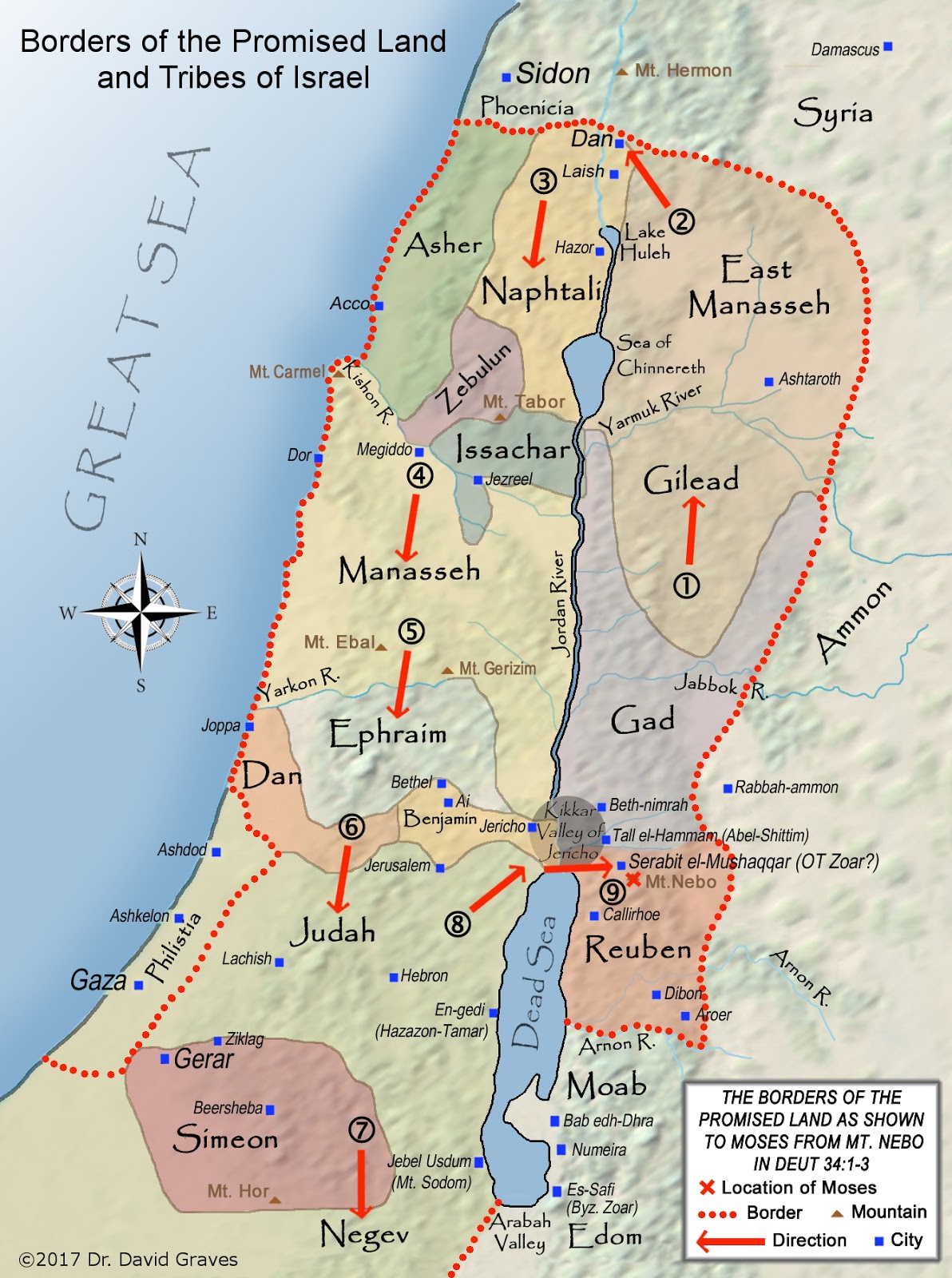
Boundaries: The land taken by Israel was bounded by the river Arnon on the south, Mount Hermon on the north, the Arabah (Jordan valley) on the east and Mediterranean on the west (v.1).
Canaanite Kings Overcome: Moses conquered the 2 kings listed in vs. 2-6 and Joshua the 31 kings listed in vs. 7-24. These kings were now all displaced and their land under Israel's control. The total area west of the Jordan was about 55 miles (EW) by 75 miles (NS). Compared to surrounding regions, the city-states of these kings were small and local.
Rather then give Israel land under the control of a larger, more organized kingdom, God gave Israel the land of multiple wicked and fragmented local war-lords, none of whom had been able to conquer the others.
Personal Response: I will see through the assignments given me by the Lord. The task of the conquest of Canaan, given to Joshua, took him about 17 years.
My Prayer: Father, make me faithful through battle and blessing, with little and especially in the dangers of wealth. May I not be distracted, discouraged or become battle-weary but love well and not turn aside.
Joshua 13
Elderly Joshua: Joshua died at 110 years (24:29) and is thought to have been about 100 years at the time referred to in this chapter (v.1). The initial conquest of Canaan has been estimated to have taken between 7 and 17 years.
Land Remaining: Yet "very much" (v.1) land remained to be
conquered. Joshua may have become too old to lead Israel in war. Yet he did not
appoint a successor. The land remaining included that of the Philistines, about
60 miles along the Mediterranean coast, the Geshurites to the south of it
(v.2) and Lebanon to the north (v.6,7).

Land Allotted: Though the conquest is incomplete, the partially gained land was to be allotted to the tribes in proportion to their size, with the exception of the sons of Joseph, Manasseh and Ephraim, who received a double portion (see map). The 8 chapters which follow give boundary details.
A job, however distasteful or difficult, not done well, will haunt the person or people who left it undone or done poorly.
A task, without a champion, will not be done well or at all, and without a well-chosen successor, God's purpose languishes.
Land East of Jordan: Reuben (v.15ff), Gad (v.24ff) and Manasseh (v.29ff) were given land east of the Jordan.
Personal Response: Since I can't do everything and need to do what is most important well, I will discern the most important and do it well regardless of difficulty. The most important ot these is to raise up, train and hand-off to called and equipped successors.
My Prayer: Father, many
task beckon. In the midst of them, daily point to that one thing which must be done,
well and completely. Lead me to those to train, work with and to succeed me.
Joshua 14-15
Allotment Process: Eleazar the priest, Joshua and heads of the 9 and a half tribes (v.2) joined to cast lots for the territory gained in Canaan. What follows is the result, tribe by tribe.
Judah: (14:6 to 15:63). Caleb, the tribal leader who with Joshua had brought the minority report of the 12 spies 45 years earlier (v.7-8), remained vigorous at 85 after years of battle (v.10-11). Caleb asked for Hebron (v.12), the region previously named for the Anakim giants (v.15 & 15:13-14) which he had driven out, and it was granted to him for his faithfulness (14:13-14).
In addition, the boundary lines for Judah received by the casting of lots are recorded in 15:1-12.
During earlier battle Joshua had offered his daughter Ashsah as wife to the victor (v.16) who turned out to be Othniel his nephew (v.17). After Joshua's death Othniel also became Israel's first judge (Judges 3:9-11). As Ashsah left her father's home, Caleb gave Othniel land in the Negev. Ashsah then asked her father also for land with springs to adjoin the arid Negev (v.18-19) and the land with springs were given.
Asking and Receiving: Caleb and his daughter knew the value and power of asking and receiving. Both requests were reasonable and not excessive, unlike those of Manasseh (ch.17)
Jerusalem: was within the territory of Judah but Judah had been unable to capture it. Control of lower Jerusalem did not come till Judges 1:8, 21 and control of upper Jerusalem not until the days of King David (2 Sam. 5:6-7).
Personal Response: I will ask and I will give to those who ask.
My Prayer: Father, may
my asking not be selfish but in line with your good purposes and my giving
generous.
Joshua 16-17
The Principle of the Lot: Vs 1-4 make clear it is God's guidance through the lot which determines the boundaries of each tribe in Canaan.
Ephraim: The boundaries allotted to Ephraim are outlined in vs. 5-9. Ephraim however chose, rather than drive out the inhabitants and do the remaining work themselves, to leave the inhabitants in place and benefit from the fruit of their forced labour (v.10).
Manasseh: Manasseh accepted the 10 portions assigned him by lot (17:5) as did the daughters of Zelophehad (17:3-4). Manasseh had already demanded and received land on the east of the Jordan (13:29-31), wanting theirs first. Despite this double portion they were not satisfied. Rejecting the outcome of the lot by which the other tribes were guided and despite the fact they had not yet occupied the land already given them (17:12), they demanded more (17:14).
To what might be attribute this greed and entitlement? Manasseh and Ephraim were raised in the court of Joseph in a life of luxury, power and ease. Initially they were royalty, not slaves and may have continued to view themselves this way, even after a king arose who knew not Joseph" (Ex 1:8).
Note also that Manasseh and Ephraim, raised in the Pharaoh's court, were exposed to the gods of Egypt rather than the God of Abraham, Isaac and Jacob. Their Egyptian attitude towards idolatry was carried over in accepting the Canaanites and their pagan religion continuing to live among them and later bringing this paganism into Israel (2 Kings 21:1–18; 2 Chron 32:33–33:20). A rotten apple spoils the entire bushel.
Joshua's Response: If Joshua had yielded to Manasseh's entitlement and greed, the entire plan of allotments would descend into a chaotic power struggle. Joshua stood strong with a hint of mockery in his response: "If you are so tough (numerous and blessed (17:14, 17), why don't you prove it, clear the land for pastureland (v.15,18) and do your job, neglected till today, and clear out the Canaanites as you were supposed to?" (v.18).
Personal Response: I will see, challenge and remove if possible rot and compromise when it first appears, to prevent it from harming the whole.
My Prayer: Father, may I resist and overcome the temptation to entitlement, first in myself. May I hold to the truth and servanthood of the Kingdom. Help me excise all forms of the rot of the sons of Joseph, both in myself and the community.
In process...please come again...
 Murray Moerman (